 Image 1 of 1
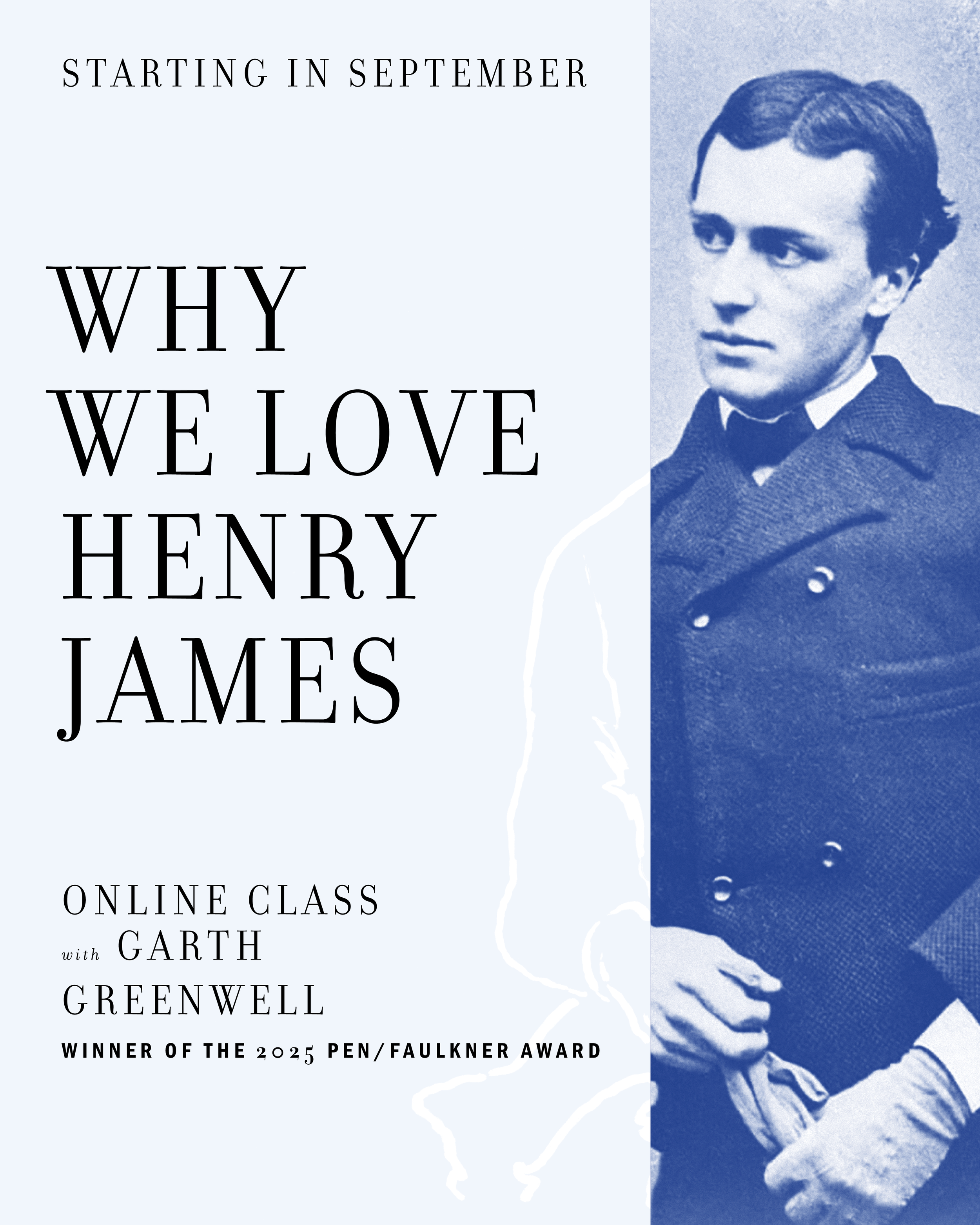
You don’t have to love Henry James to take these classes—James is my favorite fiction writer, I love him enough for all of us—but my hope is that by the end of them you’ll be a convert. Over these six classes, which can be taken individually but are designed as a sequence, we will read, relatively slowly and as carefully as we can, some of the greatest works of fiction in the English language.
James is a crucial bridge between the Victorian novel of George Eliot and the modernism of Virginia Woolf (whom James, who was friends with her parents, knew from her infancy)—and a primary source of the interiority, the focus on consciousness, that is one of the defining traits of the modern. His sentences are adventures, unfolding marvels; and he brings an intricacy and inventiveness to metaphor and imagery unmatched by anybody until Proust.
We will take a writerly approach to reading and discussing these books, paying special attention to craft and style. We’ll also repeatedly ask what it means to engage as writers, in a sustained, intense way, with a great writer of the past—and why such engagement is so crucial a part of an ongoing aesthetic education.
Students who register for all six courses receive a discount (one course is free) and also a one-on-one conference with me before the final course on The Golden Bowl.
You don’t have to love Henry James to take these classes—James is my favorite fiction writer, I love him enough for all of us—but my hope is that by the end of them you’ll be a convert. Over these six classes, which can be taken individually but are designed as a sequence, we will read, relatively slowly and as carefully as we can, some of the greatest works of fiction in the English language.
James is a crucial bridge between the Victorian novel of George Eliot and the modernism of Virginia Woolf (whom James, who was friends with her parents, knew from her infancy)—and a primary source of the interiority, the focus on consciousness, that is one of the defining traits of the modern. His sentences are adventures, unfolding marvels; and he brings an intricacy and inventiveness to metaphor and imagery unmatched by anybody until Proust.
We will take a writerly approach to reading and discussing these books, paying special attention to craft and style. We’ll also repeatedly ask what it means to engage as writers, in a sustained, intense way, with a great writer of the past—and why such engagement is so crucial a part of an ongoing aesthetic education.
Students who register for all six courses receive a discount (one course is free) and also a one-on-one conference with me before the final course on The Golden Bowl.